B2B SEO and AEO: WIN Flavor grew leads by about 145.23%
B2B SEO and Answer Engine Optimization for a Vietnamese supplier of natural flavors and food ingredients, so it is found when international buyers look for suppliers on Google and in AI tools.
- CLIENT
- WIN Flavor
- SECTOR
- Food ingredients (B2B)
- SERVICES
- B2B SEO, AEO, Content strategy, Technical SEO
- YEAR
- 2026
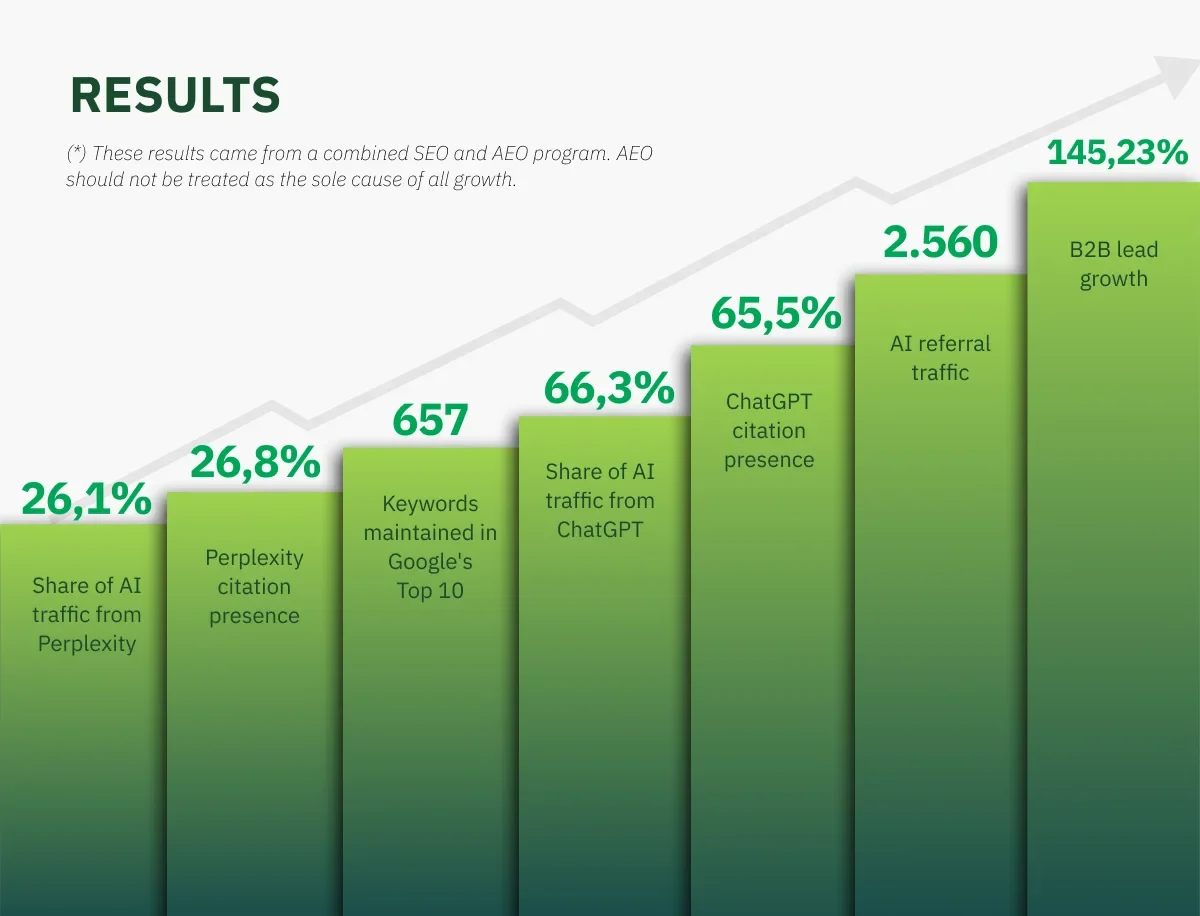
- B2B lead growth
- ~145.23%
- GA4, against the comparison period
- AI referral visits
- 2,560
- Recorded in 2026
- AI traffic from ChatGPT
- 66.3%
- Perplexity: 26.1%
- ChatGPT citation presence
- 65.5%
- Perplexity: 26.8%
- Keywords held in Google's Top 10
- 657
Challenge
WIN Flavor sells natural flavors and food ingredients to B2B buyers who study products, applications, specifications and supplier capabilities before they get in touch. Traditional SEO had already put 657 keywords in Google's Top 10, but strong rankings did not guarantee that ChatGPT, Perplexity or Gemini would put the company on a supplier shortlist.
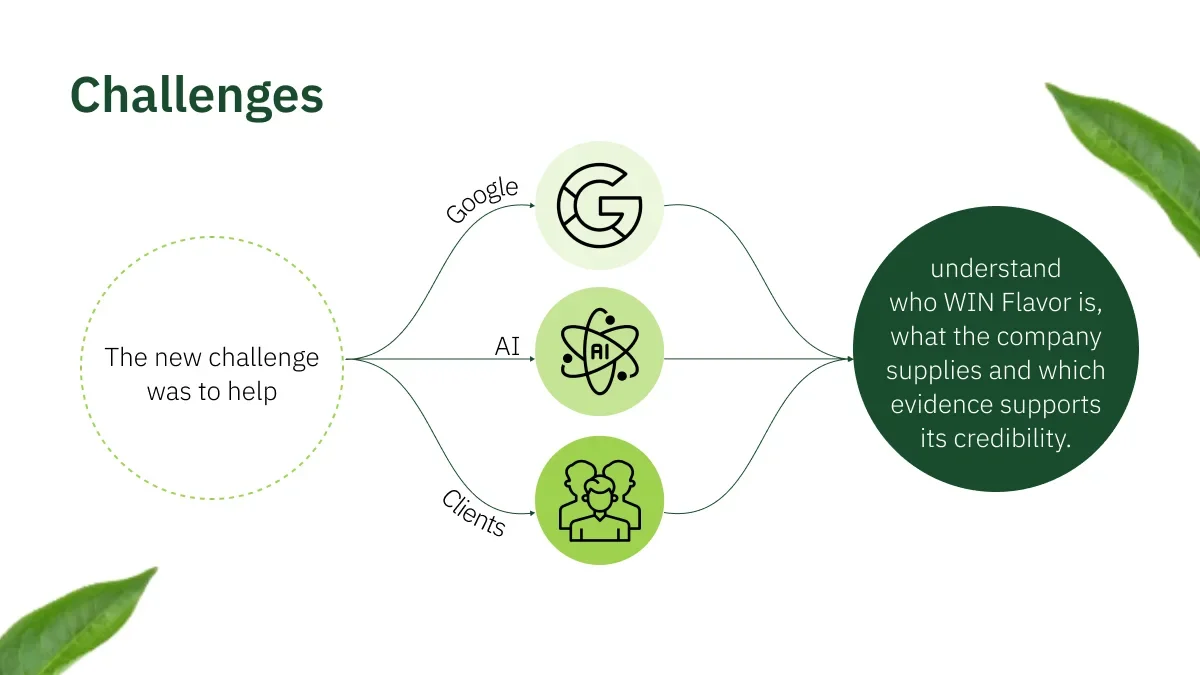
Buyers now ask AI questions such as which Vietnamese manufacturers supply reliable natural beverage flavors, which suppliers support bulk orders, and which certificates to check when choosing a flavor supplier. The job was to help Google, AI systems and buyers understand who WIN Flavor is, what it supplies and which evidence supports its credibility.
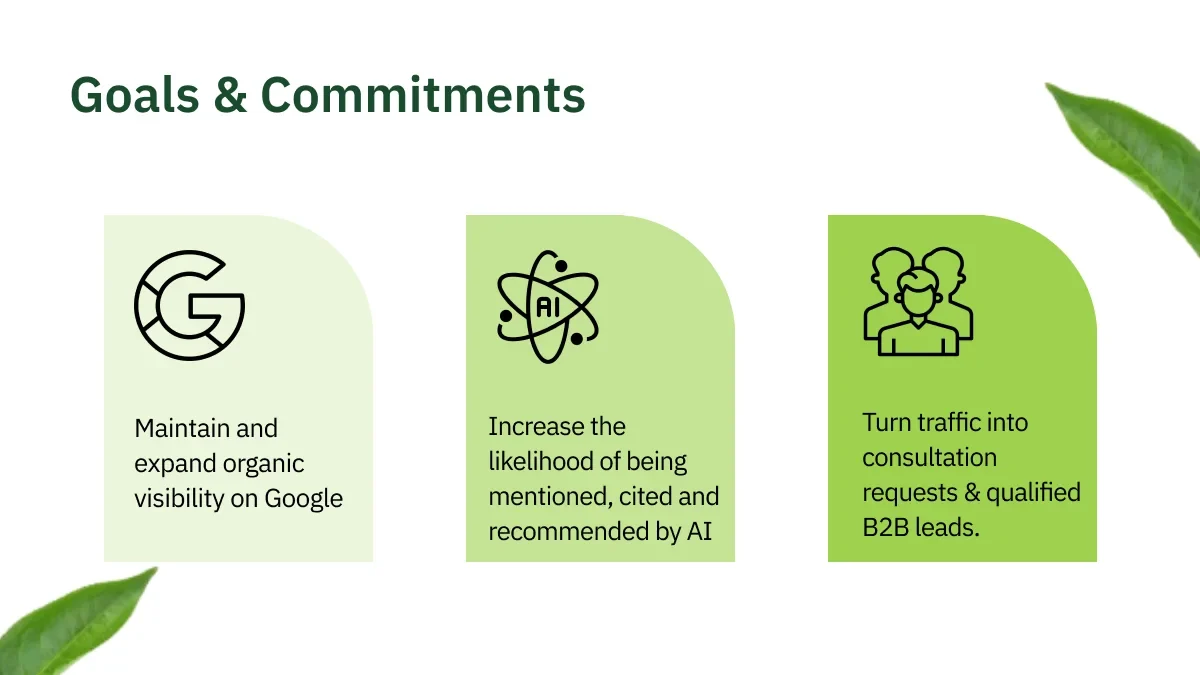
Three objectives:
- Maintain and expand organic visibility on Google.
- Increase the likelihood of being mentioned, cited and recommended by AI.
- Turn traffic into consultation requests and qualified B2B leads.
Approach
We ran SEO and AEO as two layers of one system. SEO helps buyers discover WIN Flavor in search results; AEO helps the brand appear in AI-generated answers.
Clarify brand and product entities
We standardized the key facts across the main pages: who the company is and where it operates, its products and applications, its markets and B2B customers, and its specifications, certificates and supporting documents. Consistent information is easier for buyers to verify and reduces the risk of AI systems confusing WIN Flavor with a similar entity.
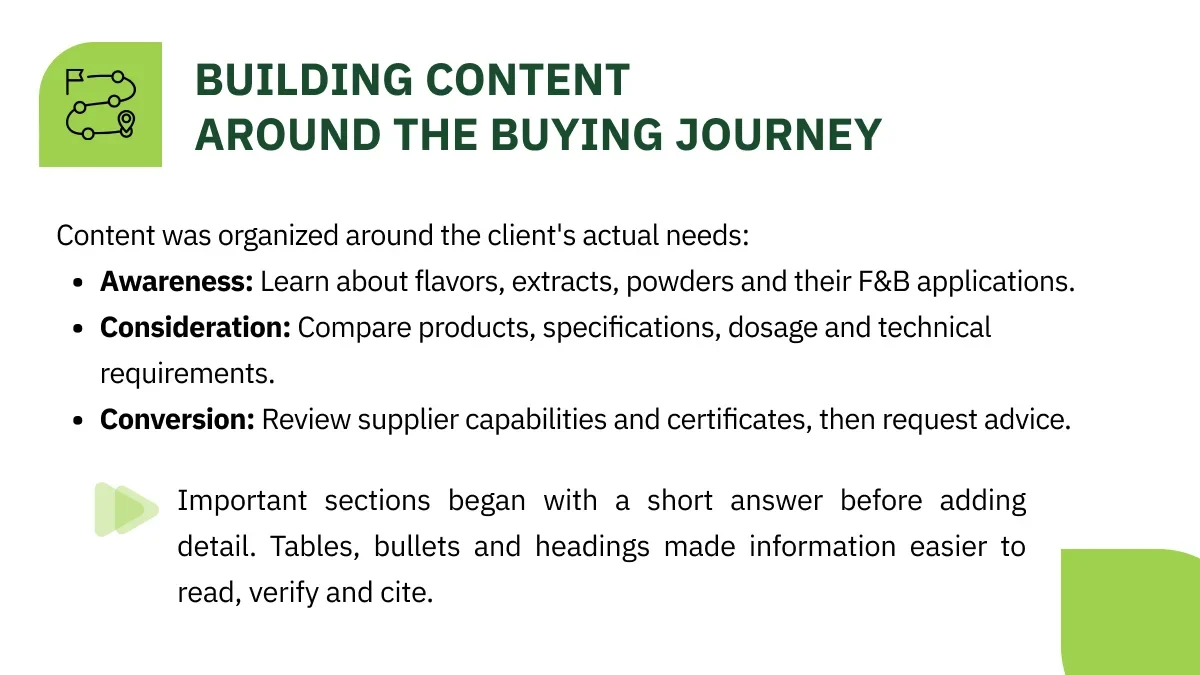
Build content around the buying journey
- Awareness: flavors, extracts, powders and their F&B applications.
- Consideration: product comparisons, specifications, dosage and technical requirements.
- Conversion: supplier capabilities and certificates, then a request for advice.
Important sections open with a short answer before the detail. Tables, bullets and headings make the information easy to read, verify and cite.
Optimize for Google and AI
We combined in-depth content, internal links, entities and structured data. Organization and Article schema clarify the company and the content type; FAQPage schema is used only where matching questions and answers are visible on the page. Schema supports information the content already explains clearly. It is not treated as a shortcut to citations.
The work spans technical SEO (crawlability, indexability, site architecture), semantic SEO (topical authority, entity relationships, search intent) and AEO (answer-first content, passage-level relevance, retrievability by RAG systems). Performance is tracked through AI visibility, brand mentions, citations, recommendations, AI traffic and qualified leads.
Test AI visibility
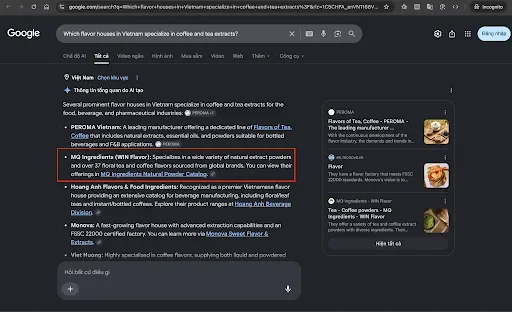
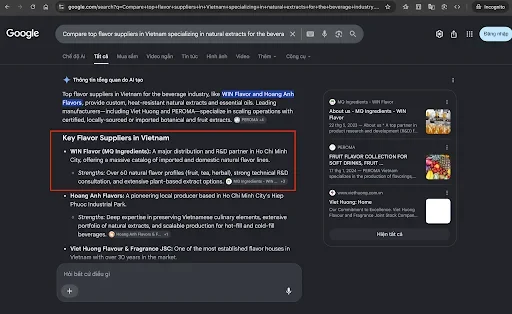
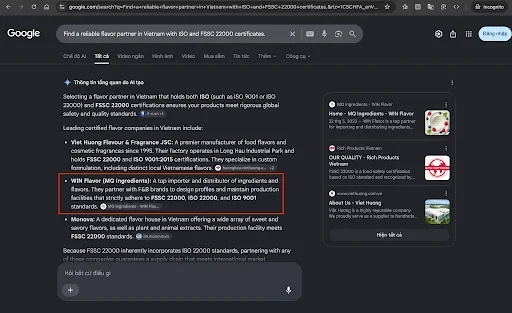
We tested brand visibility in the international market with natural prompts that follow a buyer's journey: discovery ("What are the top 5 food flavor manufacturing companies in Vietnam?"), comparison ("Compare top flavor suppliers in Vietnam specializing in natural extracts for the beverage industry") and decision ("Find a reliable flavor partner in Vietnam with ISO and FSSC 22000 certificates"). Each prompt had one clear intent and stayed unchanged across repeated tests. We recorded the engine, mode, date and location, and used fresh conversations to control context.
Three outcomes were tracked separately: a mention (the AI named WIN Flavor), a citation (the AI linked to the WIN Flavor website) and a recommendation (the AI suggested WIN Flavor as an option). For each result we also recorded the cited URL, the claim it supported and the competing sources in the answer.
Results
These results came from a combined SEO and AEO program. AEO should not be treated as the sole cause of the growth.
GA4 recorded 2,560 AI referral visits in 2026, and lead volume grew by approximately 145.23% against the comparison period. ChatGPT accounted for 66.3% of that AI traffic and Perplexity for 26.1%. Citation presence reached 65.5% on ChatGPT and 26.8% on Perplexity.
Lead growth was measured across the tracked actions: hotline clicks, Messenger clicks, Zalo clicks, sample-request submissions and form-success page views. AI-referred landing pages recorded conversions from both domestic and international buyers, across product pages, category pages and English product pages.
The pages that drew the most AI traffic were in-depth market research reports. ChatGPT sent 112, 99 and 96 visits to the reports on Vietnam's plant-milk, instant-coffee and soft-drink markets, with Perplexity adding 37, 33 and 65. These are site-wide recorded figures: deep content combined with SEO is what captured this high-quality traffic.
The most important result is not traffic or citations alone. WIN Flavor now has a system that helps customers find, understand, trust and contact the brand across Google and AI search.